
And why most organisations stop one step too early in their Continuous Improvement journey.
In my previous article written oh so long ago, I had a rant about how daily kaizen lives or dies by structure, specifically, the team leader–to–operator ratio.
The maths is uncomfortable but unavoidable. I was trying to make the case that without time, improvement cannot happen. Without the right ratio, leaders cannot coach and without coaching, kaizen becomes episodic, transient and sadly diluted. And without daily kaizen, continuous improvement collapses. Don’t worry, ops execs, AI is just around the corner and soon the bots will take care of everything. But until then, keep reading.
Fixing the ratio is not the end of the story. It’s actually the entry point into other aspects of leadership thinking which are not as explicit in the Lean Operating System manual. You have to dig around a bit in the leadership space as there isn’t a field guide for this.
What Toyota does next is what most organisations never fully grasp, and this is where Monozukuri (Mono), Hitozukuri (Hito), and Hansei come into play.
Monozukuri is “Mono (thing) “Zukuri” (making) but with a sense of pride and learning involved. Think about a sword making artisan and the care and attention that would go into the making of a samurai’s blade. You get the idea.
Hitozukuri is “Hito” (people) “Zukuri” (making). In this case developing, nurturing people to become great manufacturers, and in fact, willing to embrace Mono. This is mentorship on steroids, it is human centred, experiential, and wholly empowering.
Hansei is “Han” (change or turn) and “Sei” (reflect on, look back). In other words, as a leader reflecting carefully on your own impact as a coach and mentor on leading improvement or change.
Kotozukuri is “Koto” (value) “Zukuri” (making) meaning creating value and at a deeper level creating an environment for it to happen.
The thinking here is, if we want to see the number of improvements and capable problem solving reach and maintain a certain level, then we had better invest in making this happen. If our leaders, in a newly changed ratio are incapable of coaching, mentoring and making a psychologically safe workplace, then all we have done is layer in cost. And the goal here is to be better. And by being better we can generate value (Kotozukuri) for our customers. And what that translates into is margin! In other words we don’t put this effort in just to make ourselves feel good.
Why Structure Alone Is Not Enough
Many organisations stop once they stabilise operations. We get a visual board up, run a few workshops, parade a few execs through to drink in the glory and think we’ve cracked it.
- Standardised Work exists, usually of a questionable depth
- Leaders are closer to the floor and getting to grips with being present
- Daily problem-solving begins, with teams grappling with what PDCA actually entails
But Toyota goes further. They ask a deeper question:
How do we make sure this capability we have taken time and money to build does not degrade over time? And the answer here will not be more tools. It is a deliberate system of development and reflection, anchored in three tightly connected ideas: Mono, the work and the product, Hito, the development of people and Hansei, reflection that turns experience into learning and betterment.
Why These Three Only Work Together
Here is my critical learning over the years: Mono, Hito, and Hansei are mutually reinforcing. Remove one, and the system weakens.
Mono without Hito is a bit like analysis without an avenue to really grow in potential. Hito without Hansei leads to more of the same without expanding horizons or thinking out of the box. And Hansei without Mono is a bit of navel gazing without having an impact on reality.
And none of them survive without the precious gift of time. This is why Toyota’s advantage is not cultural magic (but it really does feel like that) It is intentional system design. Until our noble physicists have figured out this quantum mechanics malarky and we can fully grasp the notion of time with quarks predicting our measures and skewing the future, we will have to simply accept that we need to give time over to improvement.
Bringing It Back to the Team Leader Ratio
My previous article showed that, a 1:30 ratio produces minutes of coaching, whilst a 1:6 ratio produces daily development and true kaizen.
Hopefully, this article explains why that time matters. Without it Monozukuri will never have the chance to flourish, Hito is reduced to supervision, and Hansei is replaced by urgency.
With it we can explore an amazing world of self perpetuating growth, learning and development that sits just out of reach for most organisations worried to invest in a ratio.
Closing Thought
Three people named Hito, Mono, and Koto walk into a bar in downtown Tokyo:
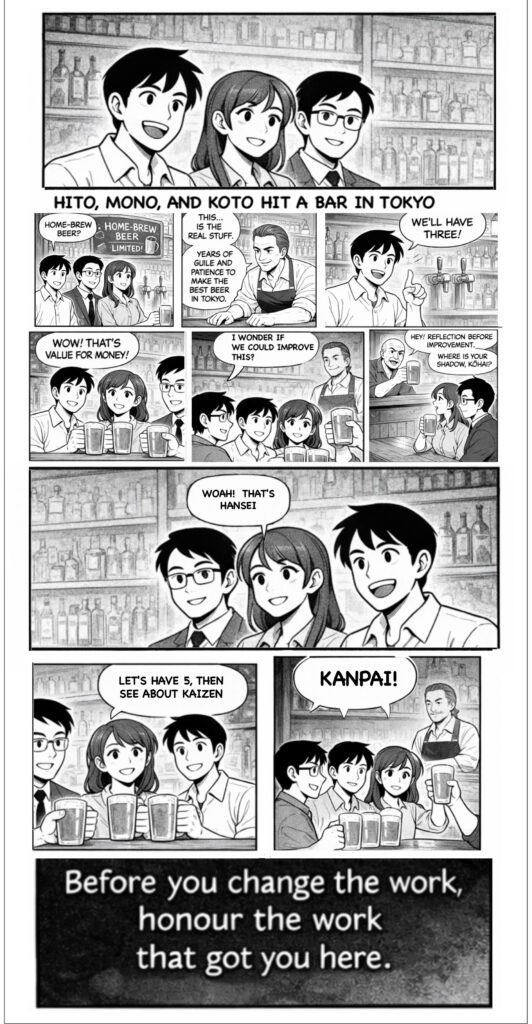
This article was nudged along by a fellow gin lover in Perth. You know who you are!
Thanks to Bob Newton for designing and persisting with the manga!
I thoroughly enjoyed this article by Louise George Kittaka on Monozukuri in Tokyo. Well worth a read and hope to visit the Nippon Department Store and take it all in. https://www.tokyoweekender.com/hidden/monozukuri-understanding-the-art-of-craftsmanship-in-japan/